|
| |
The old standard for stereo video was interlaced (field sequential), which involved utilizing the two fields of each NTSC frame into left and right half-frames. This allowed standard video systems to be used- though resolution of each eye is only half of normal vga (2x 320x480).
NOW! With a good computer, dual stream 3D video at up to 720P HD resolution can be realized. Usually L and R streams are married into a single "double-size" file and played with special stereo software.
|
|
|
|

|
PASSIVE GLASSES
STUDIO 3D can now project full-color* polarized stereo video digitally. We use a pair of INFOCUS LP-530 DLP projectors which put out 2000 lumens each. (We recommend DLP since LCD panels are themselves polarized, and will generally interfere with lens polarizers.)
A projector stand is recommended for critical alignment of projected pairs. We use a grid image for our desktop wallpaper that helps alignment. Digital keystone correction is a great help in this regard (though some fear image degradation, we've not seen it).
For more on 3D PROJECTION, click HERE.
*Anaglyphs can be projected digitally as well, with a single projector... preferably LCD due to better color gamut.
|
|
|
STUDIO 3D now uses a "SFF" (Small Form Factor) computer from Shuttle for running stereo projections. Most nVidia cards allow for "Horizontal Span" between the two outputs (to the projectors). A third monitor at the computer (via a USB to VGA adapter from Tritton) can be added for running shows without application software being seen on screen. For video, we recommend special 3D software below. Slide shows can be run from off the shelf software like POWERPOINT and ProSHOW.

|
 |
ACTIVE GLASSES
Single projector stereo is possible with shutter glasses technology. The DEPTHQ projector provides an incredible 120hz refresh rate, to eliminate any flicker. A page-flipped stereo source (from nVidia card) connects to projector, with our emitter syncing the signal via IR to the EYE-ART shutter glasses withing a 23 foot range.
Some other DLP projectors can handle shutter glasses, but at a maximum of 85hz (resulting in some flicker).
|
|
|
|
|
|
STUDIO 3D uses a pair of Canon Elura mini-DV camcorders, which allow interocular spacing from 2.5 inches (normal eye spacing) to almost any distance apart. Video streams are sync'ed in post production (Adobe Premiere). Cameras shown with wide angle attachments. Stereo video can be previewed in 3D when cameras are at normal eye spacing.
|
|
|
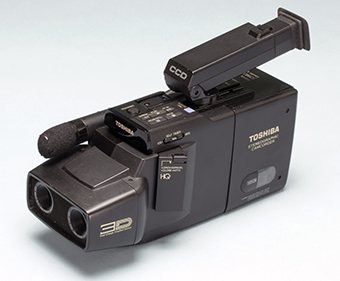
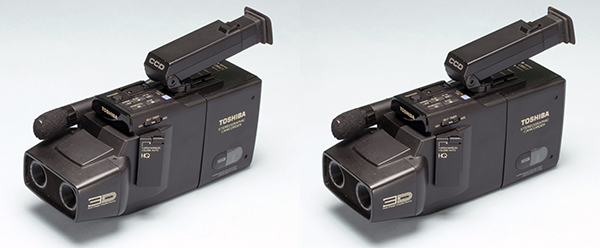
STUDIO 3D has also used a Toshiba stereo camcorder. With two built-in lenses (the only production stereo camcorder ever) it was the simplest way to get instant interlaced stereoscopic live action video. The format is NTSC with a lens separation of 2 inches (50mm). The analog video can be output directly to another deck, such as mini-dv via the composite video out cable.
Estimates are that only 500-1500 of these cameras were produced.
|
|
Additionally, stereovideos can be produced by 3D animation programs- we use 3D STUDIO Max. |
|
PERSONAL VIEWING
There are numerous stereo vieweing devices currently on the market for stereo video.
Two basic types are HMD's (head mounted displays) and LCS (liquid crystal shutter) glasses.
|
HMD's are often used for "Virtual Reality" applications, especially when combined with a head tracking system. The advantage to this system is that one is getting two completely discrete images for the left and right view, eliminating any cross-talk (ghosting). This is indeed, a "personal" displany, as only one person can enjoy the image at a time.
|
|
LCS glasses work with alternate field NTSC video on your TV and/or interlaced stereo for computer monitor viewing. The glasses are synced to the source by wire or wireless, so that the right eye is blacked out when the left eye image is on the screen, and vice versa. Computer viewing is generally preferable due to capacity for higher refresh rates~ the limited NTSC TV refresh rate (only half the usual 60 fps) causes flicker.
|
Many nVidia graphics cards support stereo 3D... currently these is the latest stereo drivers
3DLabs also support stereo with many cards. Some cards have ports for LCS stereo glasses built in.
|
|
|
3D VIDEO SOFTWARE
We have tried several software players that work quite well. STEREOSCOPIC PLAYER is shareware, and the latest version is very robust! A freeware program that is quite good is STEREO MOVIE MAKER . A more professional option from LIGHTSPEED is DEPTHQ
ADOBE PREMIERE for Stereo
In order to create two separate sync'd stereo video streams, Left/Right clips must be aligned and trimmed, then saved in separate Left/Right folders but with exactly the same names. All the transitions, moves and effects (along with audio) can be applied to all the Left clips (which had been moved to any empty folder) and a Left video stream created. Then the Left clips are removed from that folder and replaced with the Right clips. Another video stream is created with the exact same effects, but this is now the Right video stream.
This technique can also incorporate STILL image pairs.
|
|
|
 |
The VIDEO 3D Pro is the best HMD we've seen. They accept interlaced NTSC (or PAL) video, and sizes them up to the 800x600 pixel per eye resolution- which is surprisingly good. Built-in headphones, too. |
 |
The VUZIX DV920 (formerly ICUITI) is a lower cost solution, they call it "iWear". Picture looks quite good for dual 640x480, with earbud type earphones. Interface powered by 2 AA batteries or adapter... accepts composite video or vga signal. Our biggest complaint concerns design- front heavy, and hinges that move vertically, they don't sit comfortably on the nose. A strap would help.
|
 |
The eMagin 3DVISOR E800 sure looks good, but we could not get it to run on our computer... and their tech support was no help. |
 |
Newest I-VISOR FX601 is now called FMD for Face Mounted Display!) works with 800x600 OLED panels, and comes in various configurations to work with PC, video or both. We've not tested yet. |
 |
The older I-VISOR DH-4400VPD (newer version called CY-VISOR) handles video as well as PC input- both interlaced and dual stream (of course, dual stream looks a lot better!) |
LIQUID CRYSTAL SHUTTER
Shutter glasses require page-flipped stereo... we like video cards from nVidia which offer stereo drivers built in, and some feature mini-din ports for the wireless emitter (or wired glasses).
|
 |
CrystalEYES from RealD/Stereographics is an excellent (although expensive @ $795 each plus $200 emitter) shutter glass setup for the PC or Mac. |
 |
Since we've tried the NUVISION 60 GX Wireless Shutterglasses, we love them! Works great with stereo-ready graphics cards and 3D VIDEO software, but a lot cheaper than CrystalEYES. (about $350 plus emitter) |
 |
Razor 3D offers a very inexpensive ($29) wired system for viewing interlaced stereovideo on your TV. Be advised, however, that the slower refresh rate of a TV set causes flicker which most people find objectionable.
Edimensional offers wireless PC glasses with a short range (10') ($99.95).
|
 |
We offer what we think is the best value, the Eye3D wireless shutter glasses. Low price, great quality, 23' range. |
|